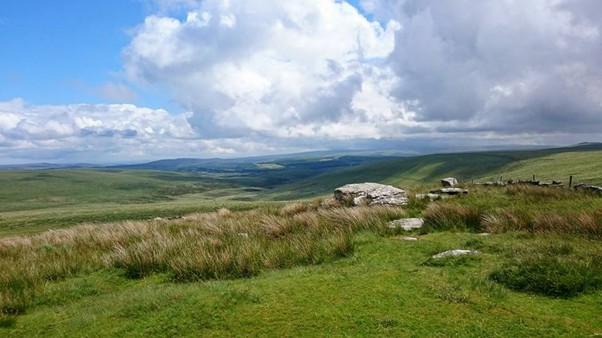
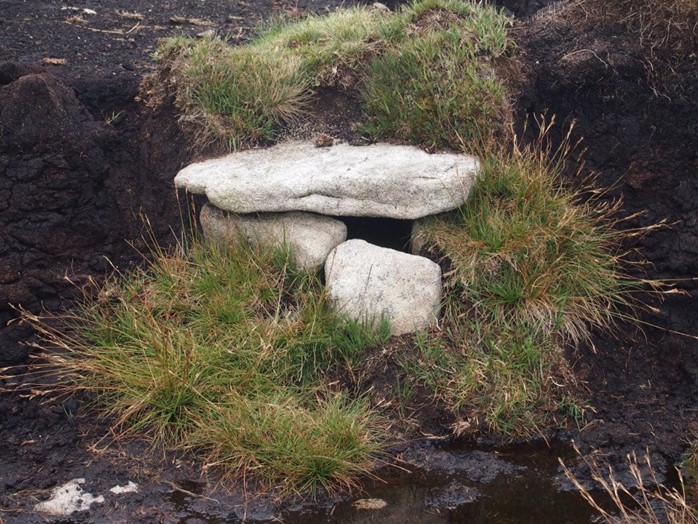
At Imbolc, I begin with a local burial I am very familiar with, high up on the open moorland of Dartmoor at a place called Whitehorse Hill (Grid Reference SX 617 854). Today it is a barren, boggy place, full of eroding peat hags and it was in one of these eroded areas that the remains of a cist (a granite burial chamber) were found.
Dartmoor is internationally important for the survival of its Bronze Age landscape, with ceremonial and burial sites in profusion. Within a few miles of Whitehorse Hill are the stone circles at Sittaford, Fernworthy and the double circle at Grey Wethers. There are numerous Bronze Age settlements and cists dotted across the surrounding hills – this was a well populated area at that time. The ground that held this burial for almost 4000 years stands proud of the surrounding land and rises to form a mound, although this may have been created later, by the extensive peat cutting in this area.
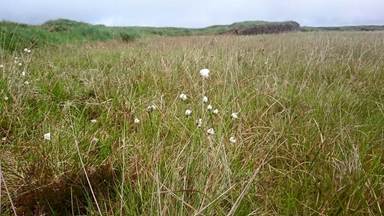
Initially, as is the policy on Dartmoor, attempts were made to stabilise and preserve the cist where it lay, but over time, it became clear that these were not proving successful and the cist would soon erode completely and be destroyed, so in 2011, an excavation was carried out to study the cist.
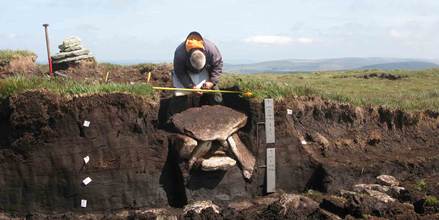
Generally, on the wet, acidic soils of Dartmoor, little organic material is preserved, but this excavation proved that there is always an exception to the rule. First, a bead was discovered – this showed that at least some of the burial’s grave goods had survived. As the excavation proceeded it quickly became clear that the Whitehorse Hill cist was about to reveal so much more. The waterlogging and lack of oxygen in this particular site inhibited bacterial decay and so artefacts which would have long since rotted away in most other environments survived.
The grave contained the cremated remains of a young adult aged15 – 25, of slight build and generally assumed to be female. She had been placed in the cist in the Early Bronze Age between 1730BCE and 1600BCE.
The siting and structure of the cist demonstrated the degree of care that went into her burial. At least two corners of the plot were staked out with hazel rods which would have guided those digging out the cist cavity and lining it with stone. The granite they used comes from the local bedrock, using naturally tapering side-stones and topped with a large capstone that was an impressive grave marker.
Her tribe gathered together purple moor grasses to line the granite tomb, laying them out carefully so that they all pointed in the same direction. She was laid on a bed of meadowsweet flowers, perhaps due to their sweet scent and traditional use in rituals and healing ceremonies, for a blessing or protection on her journey.
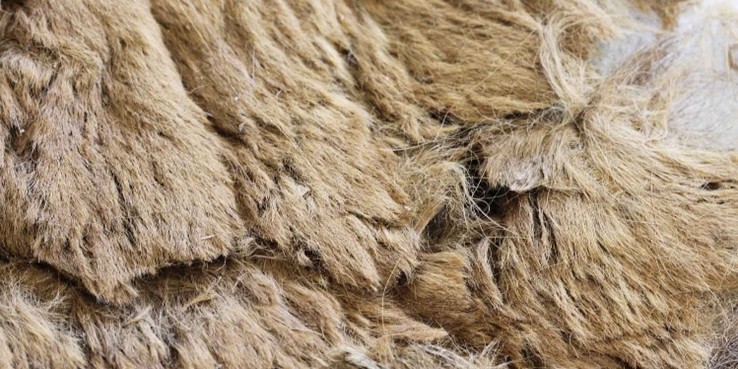
The woman had been cremated and the bone fragments that remained had been carefully wrapped in the pelt of a brown bear and fastened with a copper alloy pin. I wonder if the pelt could have been her shawl, or even her bedcover for those cold Dartmoor winter nights?
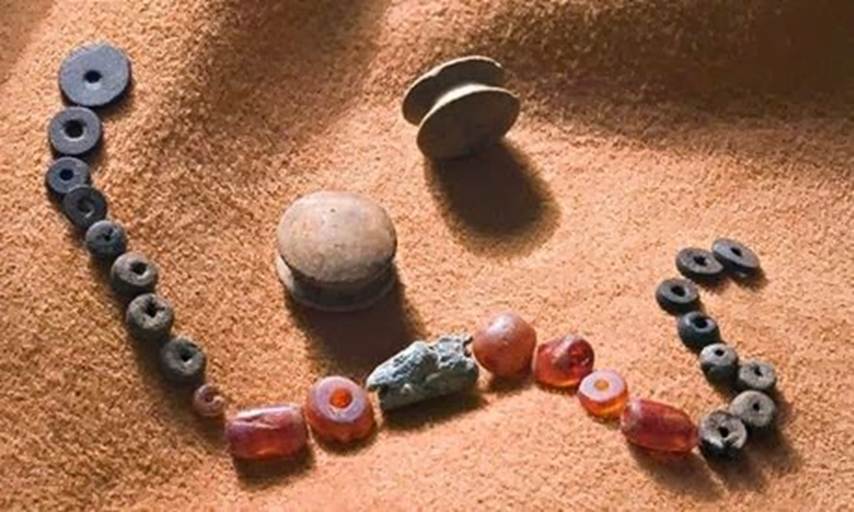
Beside her, exquisite grave goods had been placed to accompany her journey into the afterlife. There were more than 200 beads of fired clay, shale, amber and tin, which had probably originally formed a necklace. The tin was likely to be from the South West, but the clay was not local, the shale beads came from the Dorset coast at Kimmeridge Bay and the amber beads from the Baltic, demonstrating the extensive trade routes that existed at that time. Wear patterns on the amber beads show that they were old when she wore them – perhaps passed down as family heirlooms, rather like us wearing our grandmother’s jewellery.
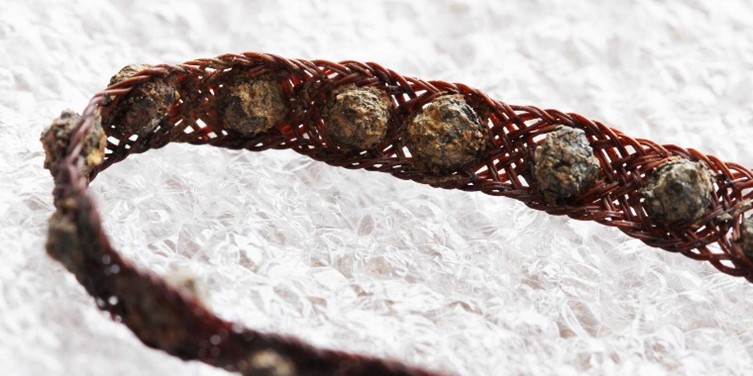
There were also some wooden studs, hand turned from Spindlewood which may have been worn as labrettes in the ears and/or lips, fragments of leather and textile woven from nettle fibre, a flint tool used for light cutting or scraping, and an intricately woven bracelet of cow hair and tin studs. These were placed inside a basket woven from lime bast and cow hair, again made with intricacy and aesthetic beauty as well as skills that would challenge many crafts folk today.
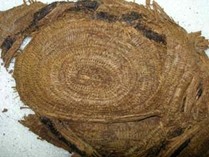
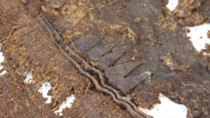
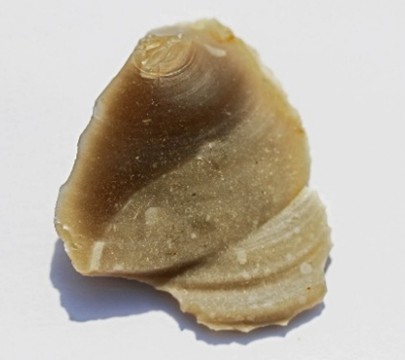
Images of nettle fibre and leather fabric, basket and flint tool all © DNPA
It is important to highlight here that this burial is almost certainly a higher status individual and thus may not reflect the way that the majority of people lived and died at that time. Most are not represented in the archaeological record so are unlikely to have been surrounded with such riches – these were reserved for the elite in society. However, the beliefs of a culture are likely to have been the same, so I imagine that all deaths were treated with some reverence and ceremony. Their grave goods may well have been much less opulent, but they still could have been chosen to reflect who they were in life in much the same way.
I find the details of this burial so moving – I can imagine this woman’s tribe witnessing her body be consumed by fire, before processing up to the grave site, someone carrying her bone bundle, another her most precious belongings, another bunches of grasses and flowers. Then the gentle laying down of her remains, deep in the dark earth. What were the prayers, the songs, the memories shared as they spent this final time with her?
Whilst there is no evidence of what the ceremony specifically involved, the fact that this woman was buried with such personal things surely demonstrates a clear belief in the afterlife. Her grave goods were high value objects – created by highly skilled artisans, some pieces many generations old – so to bury them with her would have been at cost / loss to the tribe – yet it must have been considered important to equip her for her journey and to honour her individuality. These grave goods represent not only one woman’s life, but the care and respect that Bronze Age people gave to their dead.
It makes me ponder what we offer as gifts to our dead today. What do we offer now as grave goods, in this digital age? What might we need on our journey forth? How many of us think about the possessions we would want to be buried with? What would be important to you, what would demonstrate who you were?
The cremation and burial would have required much time and effort by her tribe. She was cremated elsewhere, using a pyre of oak wood and her remains gathered from the ashes. The grave site needed to be selected, the grave marked out with stakes and dug carefully in the wet peat soil. The granite to line the grave needed to be found and gathered – these were unworked, so the appropriate sized stones needed to be located, then transported over difficult terrain. The point here is the time, devotion, respect, reverence and love that has been fully and clearly expressed in her burial rites. This would have taken days in ceremony, in active grieving. Compare this with the narrow window of socially acceptable grieving allowed humans today and we must consider the impact for the soul journeying into the afterlife and for the emotional health of those left behind.
In this time when funerals themselves can even be considered by many a hindrance rather than a necessary element of the grieving process, when so many people chose direct cremation to avoid the fuss, the cost, the pain – what are we losing by not holding such deeply personal ceremonies to honour our dead? How much would our communities benefit from coming together to grieve, to pay our respects? To work together to craft meaningful remembrance and to ceremonially let our loved ones go?
Celebrating life and honouring a death is just as relevant, just as important for us now, for our dead, for our communities – as it was for this young woman, almost 4000 years ago.
To learn more about Whitehorse Hill Woman:
- Whitehorse Hill – An Early Bronze Age Burial, ISBN 978-0-905981-82-6
- The excavation report – Preserved in the Peat: an extraordinary Bronze Age burial on Whitehorse Hill, Dartmoor, and its wider context, ISBN 978-1785702600
- The Whitehorse Hill finds form part of the archaeology collections at The Box, Plymouth.
- An exhibition with replicas of the grave goods is on display at DNPA’s Postbridge Visitor Centre.
No responses yet